Discovery of the hidden skeleton in the Garden of Eternal Rest
The Thursday Murder ClubThe Discovery of the hidden skeleton in the Garden of Eternal Rest turns an expected cemetery excavation into evidence of a concealed burial: Bogdan finds two sets of remains where one grave should hold one body. The discovery first forces him to choose between preserving what he has found and keeping the work moving; later, Elizabeth helps him confirm the arrangement and decides that the police need not be told yet.
Excavation and discovery
Bogdan is digging while the cemetery faces the prospect of mechanized excavation. He knows a machine could expose a row of graves in minutes, particularly if its operators do not take care, so he works neatly with his shovel while he is alone. In the graveyard’s top corner, his shovel strikes something solid. It is not the coffin lid he expects: beneath stones and roots, he uncovers a white bone. The find contradicts his reason for digging there, since he had expected no coffins or bones at that spot.
Rather than immediately burying the evidence again, Bogdan concludes that uncovering a bone makes him its guardian. With no smaller tool, he kneels and clears earth by hand, trying not to disturb what he has found. As he shifts to reach further, he realizes the firmness beneath him is not compacted earth but the oak lid of a coffin. That makes the scene harder to interpret: the bone outside the coffin and the coffin beneath him seem to belong to different burials, yet the grave has not been opened in any ordinary way.
Two burials in one grave
Bogdan works quickly, without pausing for ceremony. He exposes more bones and a skull, taking care not to move it, then uses the blade of his shovel to prise open the lower part of the coffin. Inside is another skeleton. The arrangement is starkly legible: one set of remains inside the coffin, another outside; one small, one large; one grey and yellow, the other cloud-white. The grave contains both the body where it belongs and a much newer body where it does not.
The contrast raises possibilities without resolving them. Bogdan wonders whether an old burial might have involved a cheap coffin or some other shortcut, and whether the remains could reflect past burial practices or a period of disease. But he recognizes that these explanations are only possibilities, not answers. He also anticipates that a formal examination would take time: investigators would use small tools and might need to inspect the surrounding graves as well. That process could delay the development and leave him waiting for work, while still failing to explain what happened.
Bogdan’s decision
With no time to think at leisure, Bogdan hears a siren approaching. He takes it to be an ambulance at first, then reasons that it must be the police and expects the barricade to be cleared. He does not leave the grave exposed for their arrival. Instead, he hauls himself out and starts filling it in again, intending to ask Ian Ventham what to do. The discovery therefore begins with a concealment of its own: Bogdan does not destroy the remains, but temporarily covers the grave rather than reporting what he has found.
That choice reflects the practical pressures surrounding the excavation as much as uncertainty about the remains. A full investigation might delay the work and extend beyond this single grave; doing nothing, however, would leave a discovery that Bogdan feels responsible for. The tension is not resolved by the first find. It moves into a private decision about whom to trust and when to bring the police into the matter.
Elizabeth examines the grave
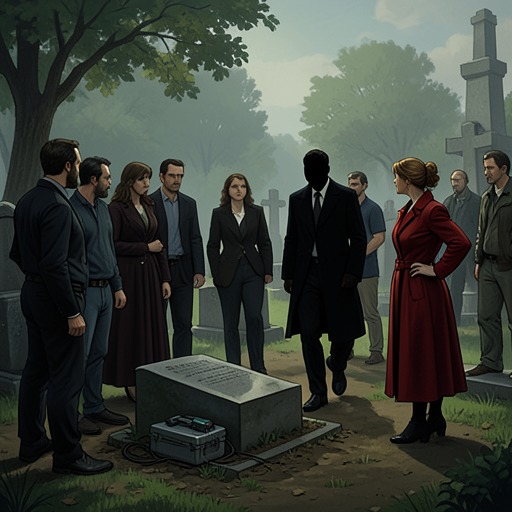
Later, Elizabeth watches Bogdan dig again in faint torchlight and imagines that he may have uncovered money. When he calls her over, she sees the same discovery he saw on the morning Ian Ventham was murdered: bones and a coffin lid together in the grave. She had expected that a grave might contain a body, but not this particular arrangement. Her initial speculation about a hidden haul gives way to the evidence in front of her.
Elizabeth asks whether Bogdan opened the coffin. He confirms that he did so to check, and then exposes part of the lid again to show the older bones inside. She distinguishes the two burials: one body in its proper place, the other much newer and out of place. Bogdan admits that he could have told the police but was unsure how they would respond. Elizabeth accepts that he did the right thing by coming to her; although she allows that they may eventually need to speak to the police, she advises that they wait for now.
Significance
The discovery changes the grave from an obstacle in a development project into a concealed history requiring explanation. Its paired remains make the central fact visible before its cause is known, while the repeated covering and reopening of the grave shape the event around delayed disclosure. Bogdan’s careful handling, followed by his decision to conceal the site temporarily, places stewardship and practical self-interest in uneasy proximity. Elizabeth’s examination does not solve the mystery, but it turns an uncertain private find into a shared investigation and establishes that the newer remains cannot be accounted for by the older burial alone.